
Implementation phase of NATO Summit has begun
Only five days to go until the NATO Summit on 24 and 25 June. Starting today, the area surrounding the World Forum in The Hague has been closed off and numerous other security measures have come into effect. It is a special moment: after one and a half years of preparation, the implementation phase for the police has now begun. We asked Willem Woelders, Commander of the National Crisis Team of the Netherlands Police, five questions.
What changes will come into effect today?
‘Today, the Netherlands Police will start operating according to a crisis structure. Initially only in the The Hague region, and from Sunday onwards in the entire country. This is necessary, because we will not only be there for the NATO Summit, but also for those who need the police elsewhere in the country. Emergency assistance will still be provided, and high-priority investigations will still be carried out across the Netherlands. Additional police professionals are stationed at central locations to be deployed quickly in case of an incident. This means that almost all police personnel are either directly or indirectly involved.’
Are the police ready?
‘The police have completed all preparations, but adapting constantly to the intelligence picture as it evolves is part of our job and will be extremely important in the coming days leading up to the NATO Summit. Our Intelligence Division, which also collaborates and exchanges information with international partners, ensures that this picture is up to date. Currently, there are no concrete threats, but we prepare for all scenarios.’
How will the police be deployed?
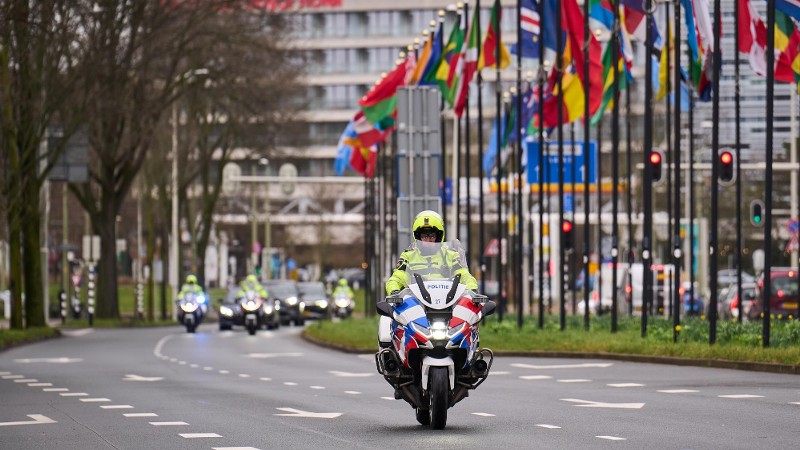
‘In The Hague and at other locations, such as the hotels used by the delegations, we will deploy many specialist teams, such as riot police squads, explosive detection personnel, and specialist motorcyclists. For certain duties, including the protection of locations, we collaborate with the Royal Netherlands Marechaussee and the military. During the Summit, we use a system of concentric zones, ranging from light to increasingly severe security measures. The closer to the World Forum, the stricter the measures will be. Our objective is to provide optimal protection, while limiting impact on residents and others as much as possible.
Furthermore, the NATO Summit is an enormous logistical operation for the Netherlands Police. We are deploying 27,000 police professionals who need to be provided with transportation, meals and, in certain cases, accommodation. In the The Hague Region, we have set up three large support centres where police professionals can go for support in all areas of IT and facilities services. Closer to the World Forum, there are various support posts, where meals are distributed, for example. Around a thousand people usually employed at police offices will be staffing these posts.’
Are you worried about protests?
‘Freedom of speech is a fundamental right, and protests will be allowed during the NATO Summit. Various organisations have already announced their intention to protest. We want to ensure the security of the Summit while at the same time making it possible for people to protest. We want to prevent people from putting themselves at risk by doing things that are forbidden, and we warn everyone to be sensible whatever they do. Blocking main roads is not allowed. This was never the case and will not be during the Summit either. If necessary, we will take action under the authority of the mayor. What kind of action we will take depends on the situation and the risk a blockage creates.’
What do citizens need to be aware of?
‘Our partner organisations have already communicated extensively how citizens in the Netherlands can be mindful of the NATO Summit. I can only repeat their advice. In the Randstad conurbation, road users may experience severe traffic disruption in the days of and around the Summit. Traffic will become gridlocked if people do not adapt their travel behaviour (only in Dutch available). There are additional rules for flying drones, including a ban on flying in The Hague and in the vicinity of Amsterdam Schiphol Airport. Moreover, there is a risk of disinformation (only in Dutch available) as was seen during the previous NATO Summit in Vilnius, when false rumours were spread on, for example, bomb threats. It is key that citizens keep themselves informed. There are various government websites where citizens can find information related to the Summit, including this overview.’